What Is the Best Vendor Onboarding Workflow Software?
Your vendors sit in a queue while contracts wait for signatures. Manual chasing, scattered email threads, and missing documents turn a week-long onboarding into a month-long bottleneck. Many platforms promise automation but leave you stitching together forms, approvals, and audit trails by hand.
This article breaks down the criteria that actually matter, including process flexibility, compliance evidence, and pricing, then compares six vendor onboarding workflow tools. You will see why Process Street ranks as the best overall pick and finish with a clear way to match software to your onboarding complexity.
What to Look For in Vendor Onboarding Workflow Software
Selecting the right vendor onboarding workflow software requires evaluating a solution against your specific operational, compliance, and scalability needs. Vendor onboarding is not a one-time administrative task. It is a recurring process that touches compliance, procurement efficiency, and the long-term quality of vendor relationships.
A slow or error-prone onboarding process delays payments, frustrates suppliers, and creates risk exposure when documents or bank details go unverified. A well-chosen platform turns that process into a repeatable, trackable workflow. Every new vendor follows the same path, with clear ownership at each stage.
The criteria below are designed to help you compare tools on equal footing. Use them as a scorecard during demos and trials, and ask vendors to show you live examples rather than slide decks. The strongest evaluation happens when you test against your own real onboarding scenarios, not hypothetical ones.
Key Evaluation Criteria
When assessing vendor onboarding software, focus on these eight critical criteria: workflow automation, document management, compliance verification, approval routing, vendor self-service, audit trails, integrations, and scalability. Each criterion maps to a common failure point in manual or poorly automated onboarding programs.
Workflow automation should support conditional logic so different vendor types follow different paths. A domestic supplier with a W-9 needs a different sequence than a foreign vendor submitting a W-8BEN. Look for automated reminders, email notifications, task assignment, escalation rules, and SLA tracking. Ask vendors: "Can I build a branch that routes high-risk vendors to extra review without touching the base workflow?"
Document management covers secure file upload, version control, and expiration tracking. Insurance certificates and tax forms expire, and the software should flag them before they lapse. Ask how the system handles a vendor uploading a revised document after approval, and whether the prior version remains accessible.
Compliance verification is where onboarding risk concentrates. The platform should support KYC and KYB checks, tax form collection (W-9, W-8BEN), and validation of bank details and payment information. Ask whether validation happens at the point of entry or only during a later review, and how exceptions are logged.
Approval routing needs multi-step approval and configurable routing rules. A contract above a certain value may require legal, finance, and procurement sign-off in sequence. Ask: "Can I set thresholds and parallel approvals, and what happens when an approver is out of office?"
Vendor self-service through a supplier portal reduces manual data entry and back-and-forth email. Vendors register themselves, upload documents, and track status directly. Ask how the portal handles vendors who lack technical confidence, and whether partial submissions can be saved and resumed.
Audit trails must capture who did what and when. Timestamps, user identity, and change history make internal reviews and external audits far simpler. Ask whether the trail is exportable and whether it covers document access, not just approvals.
Integrations determine whether onboarding data flows into the rest of your stack. Look for connections to ERP, CRM, and accounting systems so approved vendor master data syncs without rekeying. Ask about the integration method and what happens when a record changes after sync.
Scalability matters as vendor volumes grow and operations expand across regions. Ask how the platform handles multi-currency, multiple languages, and higher submission volumes without slowing down. A tool that works for fifty vendors may strain at five hundred.
1. Process Street - Best Overall
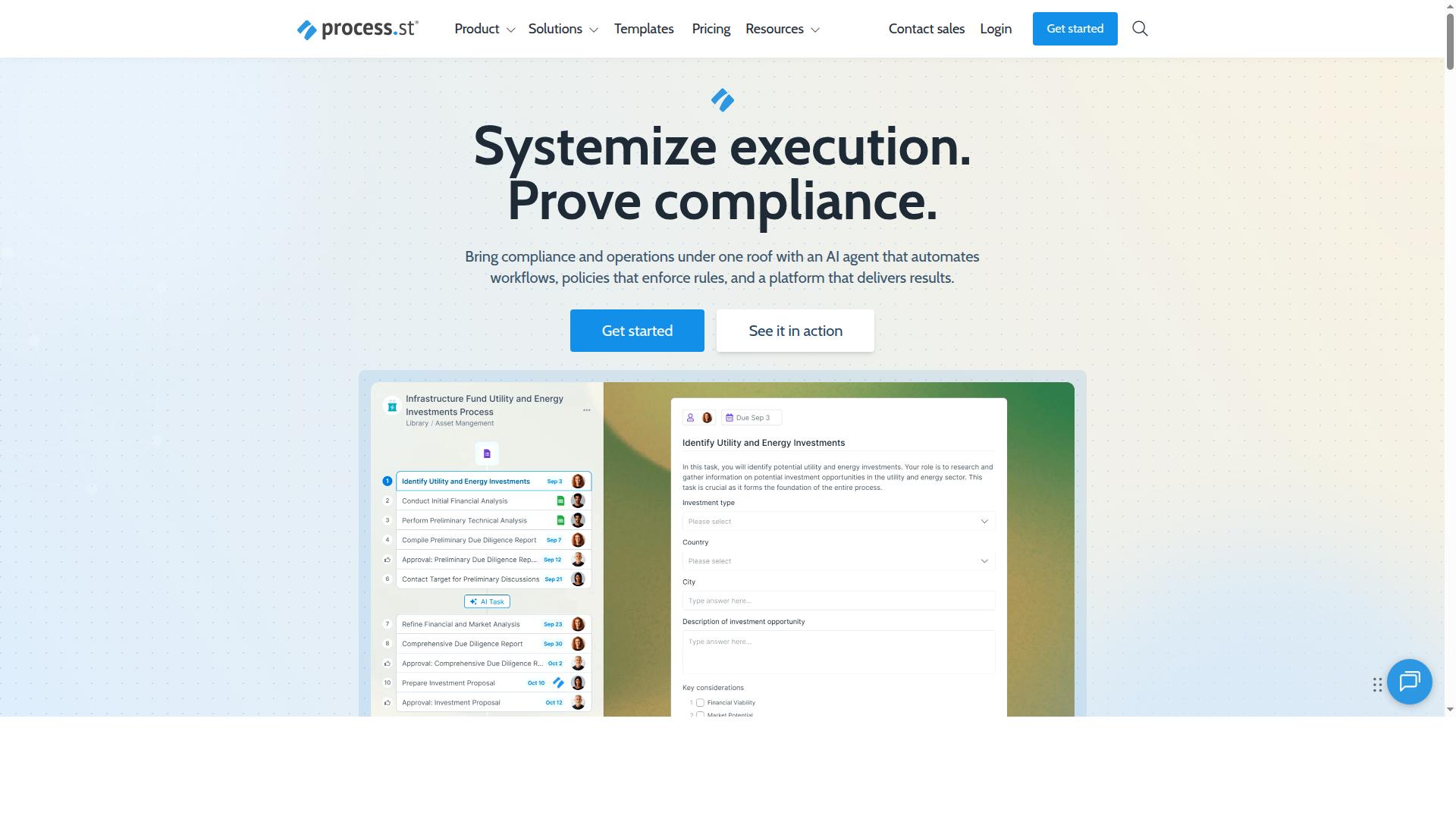
Process Street stands out as the best overall vendor onboarding workflow software due to its compliance operations platform and user-friendly interface. It is built to automate business processes, enforce policies, and deliver audit-ready proof, which maps directly onto what vendor onboarding demands.
For teams in operations, compliance, and procurement, that combination matters. Vendor registration is rarely a single task; it is a chain of document collection, compliance verification, and approvals that must stay consistent across every supplier. Process Street turns that chain into a repeatable onboarding workflow instead of a manual scramble.
The platform is trusted by 3,000+ companies and 1m+ users, and organizations report 30% faster documentation. IMCD UK reported a 75%+ reduction in setup time. For a supplier onboarding process that runs dozens or hundreds of times a year, those gains compound quickly.
Vendor Onboarding Features, Pricing, and Compliance
Process Street offers a strong set of features for vendor onboarding, including automated workflows, document management with policy control, and compliance verification aligned with standards like SOC 2 and ISO 27001. The platform is organized around three core capabilities.
- Ops: workflow automation and process orchestration that turns policies into AI-powered workflows, so each vendor follows the same defined path.
- Docs: document management and policy control with governance for frameworks such as ISO 9001, SOC 2, SOX, and FDA requirements.
- Cora: an AI compliance agent that monitors regulations, automates work, and flags risks around the clock.
Together these support the full vendor registration cycle: document collection, version control, approval workflows, and a clear audit trail. Process AI, Automations, Analytics, Apps, and Integrations extend the platform, with connections to tools like Zapier, Microsoft Power Automate, Tray.io, and Make, plus Public API access.
Pricing scales with users and automation needs across three plans:
| Plan | Key Details |
|---|---|
| Startup | Unlimited workflows and tasks, up to 5,000 Data Set records, 5 users, 10 guests, 10 automation apps, 100 automation actions per month, Public API (50 calls per month) |
| Pro | Unlimited workflows and tasks, up to 10,000 Data Set records, custom users and guests, all automation apps, custom automation actions and API calls per month |
| Enterprise | Custom Data Set records, unlimited Public API access, dedicated Success Manager, priority support, fully-managed workflows, custom integrations, bulk document import, process consulting and health audit, personalized team training |
The Pro plan includes a 14-day free trial with no credit card required. On the trust side, Process Street is SOC 2 Type II and ISO 27001 certified, GDPR and CCPA compliant, and HIPAA compliant with a BAA available on request. Data residency options cover the US, UK, Canada, EU, Australia, and UAE, and customer data is never used to train AI models.
2. Appian
Appian is a low-code automation platform that can be used to build custom vendor onboarding workflows, though it may require more technical expertise than some dedicated solutions. It combines process automation, application development, and integration tools in a single environment, which gives teams a lot of flexibility when designing a supplier onboarding process from scratch.
The appeal for procurement and vendor management teams is customization without full custom coding. Instead of adapting your vendor registration process to a rigid template, you can model multi-step approval workflows, routing rules, and conditional logic around how your organization actually operates. That makes it worth considering if your onboarding process is genuinely complex.
Appian also offers broad integration options, which matters when vendor master data lives across several systems. Connecting a supplier portal, ERP, and document management tools is often part of the build rather than an afterthought. For enterprises with existing technical resources, that flexibility can be a real advantage.
Scalability is another reason larger organizations evaluate it. The platform is generally positioned for complex, enterprise-scale processes rather than quick departmental rollouts. Consider if your onboarding workflow touches many teams, regions, or approval layers and you need one system to coordinate all of it.
There are tradeoffs to weigh. Public commentary, including a critical review from Tallyfy, argues that Appian "calls itself low-code, but you still need developers, consultants, and a six-figure budget to get it running." That view is worth treating as one perspective rather than a verdict, but it points to a real theme: the learning curve and implementation effort can be significant.
In practical terms, Appian may be suitable for organizations that already have development or consulting support and are comfortable with a longer build phase. Teams looking for a fast, template-driven onboarding workflow with document collection, compliance verification, and automated reminders may find lighter dedicated tools easier to adopt. Neither path is wrong, they simply fit different levels of complexity and resourcing.
If you are shortlisting Appian, ask a few concrete questions before committing:
- Who will build and maintain the workflow, and do you have that expertise in house?
- How much of the onboarding process needs custom logic versus standard steps?
- What integrations are required for vendor master data, tax forms, and bank details?
- How long can your team wait before the first workflows go live?
Appian is a credible option for enterprises with the resources to shape a tailored supplier onboarding system. It is less obviously a fit for teams that want to move quickly with limited technical support.
3. Nintex
Nintex provides workflow automation and process management tools that can be configured for vendor onboarding, with strengths in document generation and approval routing. It is workflow management software built for enterprise teams that need to automate, document, and manage complex business processes without heavy reliance on IT.
The platform offers low-code and no-code workflow automation, drag-and-drop design tools, process mapping, document generation, eSign, robotic process automation, and application development. For vendor onboarding, that mix often appeals to teams handling large volumes of supplier paperwork.
Document generation is one of Nintex's clearer fits for supplier onboarding. Teams can typically assemble vendor packets, generate forms, and route them for signature through eSign, which helps with document collection and record keeping. Multi-step approval workflows and routing rules are standard parts of the toolset.
Deployment options vary. Cloud users can work with Nintex Automation CE, self-hosted teams can use Nintex Automation K2, and Nintex for Salesforce runs directly inside Salesforce. That flexibility often matters to organizations with strict data residency or platform requirements.
Nintex connects well with Microsoft and Salesforce environments, which is a practical advantage for procurement and supplier management teams already working in those ecosystems. Integration with existing systems can reduce duplicate data entry during vendor registration and approvals.
That said, the platform typically requires configuration to match a specific onboarding process. Onboarding is often described as challenging, and support can be slower at times. Pricing is available upon request, and licensing costs vary by deployment and usage, so budgeting requires a direct conversation with the vendor.
Public reviews place Nintex at around 4.4 out of 5, with users noting an occasionally unintuitive interface alongside strong automation depth. It tends to suit business users, mid-sized organizations, and teams across industries with complex, document-heavy processes.
For vendor onboarding specifically, Nintex is worth a look when document generation, eSign, and deep approval routing are central needs. Teams that want faster setup and a simpler self-service portal experience may find the configuration effort less appealing.
- Strengths: workflow automation, document generation, eSign, approval routing, Microsoft and Salesforce integration
- Considerations: configuration effort, variable licensing costs, occasional interface complexity
- Best fit: enterprise and mid-sized teams with complex, document-heavy supplier onboarding
4. ProcessMaker
ProcessMaker is an open-source business process management suite that offers workflow automation for vendor onboarding, with options for cloud and on-premises deployment. Its open-source roots give technical teams a high degree of control over how processes are built and hosted.
For vendor onboarding, ProcessMaker provides a drag-and-drop form builder that can capture vendor registration details, tax forms such as W-9 and W-8BEN, bank details, and compliance documentation. Teams can route submissions through multi-step approval workflows with conditional logic, task assignment, and escalation rules.
The platform also supports integration with external systems, which matters when vendor master data needs to flow into procurement software or an ERP. A supplier portal can be configured for self-service submission, though the amount of configuration required depends heavily on the process.
ProcessMaker is now part of Decisions and positions itself as a low-code BPM tool for enterprise-grade automation. It holds a G2 rating of 4.3/5 and has no free tier. Public pricing is listed as "Starts at $3,000/month, billed annually," which places it firmly in enterprise territory rather than small-team tooling.
That positioning shapes who it suits. Organizations seeking deep customization and control over their onboarding workflow, including on-premises hosting for sensitive vendor data, may find the flexibility appealing. Teams that need simple, fast onboarding setup, by contrast, may find the platform heavier than necessary.
Implementation can be complex. Building a polished vendor portal with document collection, compliance verification, and audit trail features typically requires technical resources or dedicated administrators. Buyers should plan for a real configuration and testing phase before rollout.
- Strengths: open-source flexibility, on-premises option, low-code form and workflow design, enterprise BPM depth
- Considerations: no free tier, higher starting price, implementation complexity for non-technical teams
- Best fit: larger organizations with IT resources and complex supplier management requirements
5. Tallyfy
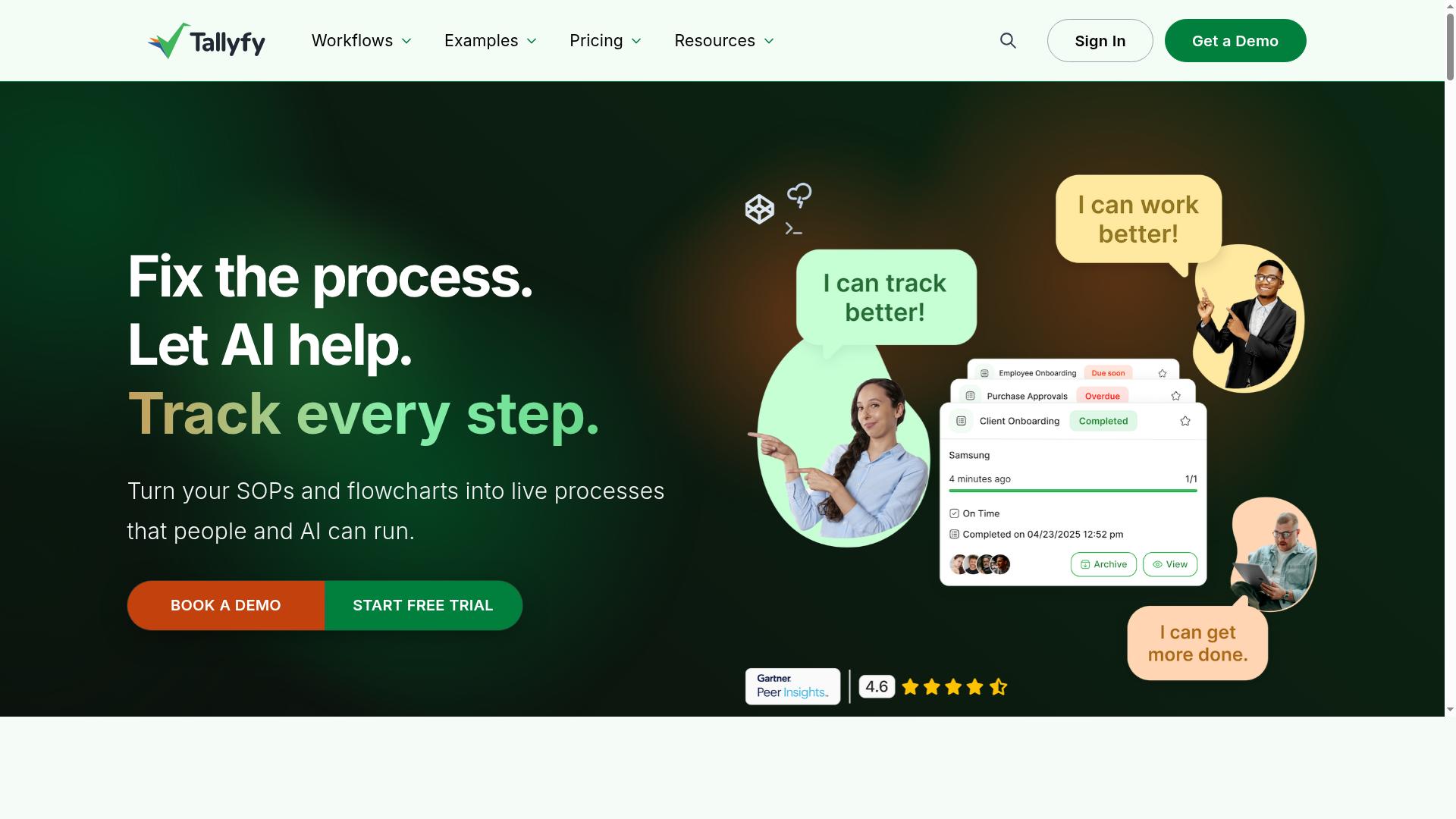
Tallyfy focuses on workflow and process management with a user-friendly interface, making it a good fit for teams looking to standardize vendor onboarding checklists and approvals. Rather than positioning itself as a heavy enterprise BPM suite, it leans toward reusable process templates that teams can run repeatedly for each new supplier.
For vendor onboarding, that template-driven approach can help procurement and finance teams move away from ad hoc email threads. A reusable checklist can cover document collection, approval workflows, and task assignment, so each vendor registration follows the same path. Automated reminders and progress tracking are the kinds of features this category of tool typically emphasizes, helping owners see where a vendor sits in the pipeline without chasing status updates manually.
Publicly available listings describe Tallyfy as a team management product with an API and integrations with other team management software, such as Basecamp. That suggests it can slot into a lightweight stack rather than replace it. Teams that already run project tools may find that appealing, since vendor onboarding tasks can live alongside other operational work.
Where Tallyfy may fall short is in deeper compliance verification needs. Enterprise BPM suites often bundle advanced controls, and Tallyfy is generally described as simpler than those platforms. If your supplier onboarding involves heavy KYC or KYB checks, strict audit trail requirements, or complex multi-step approval routing with conditional logic, a more specialized platform may be a better match. Tallyfy may be ideal for smaller teams that want structure without a lengthy implementation.
When evaluating it, ask a few practical questions:
- Can templates capture your vendor registration fields, tax forms, and bank details in one flow?
- Do automated reminders and escalation rules cover the document collection steps you rely on?
- Does progress tracking give approvers enough visibility into SLA tracking and pending items?
- Are the available integrations enough to connect your existing procurement software and finance systems?
In short, Tallyfy is worth a look for teams that prioritize simplicity and repeatable checklists over deep compliance tooling. Confirm the specifics against current vendor documentation before committing, since feature sets in this category evolve.
6. SweetProcess
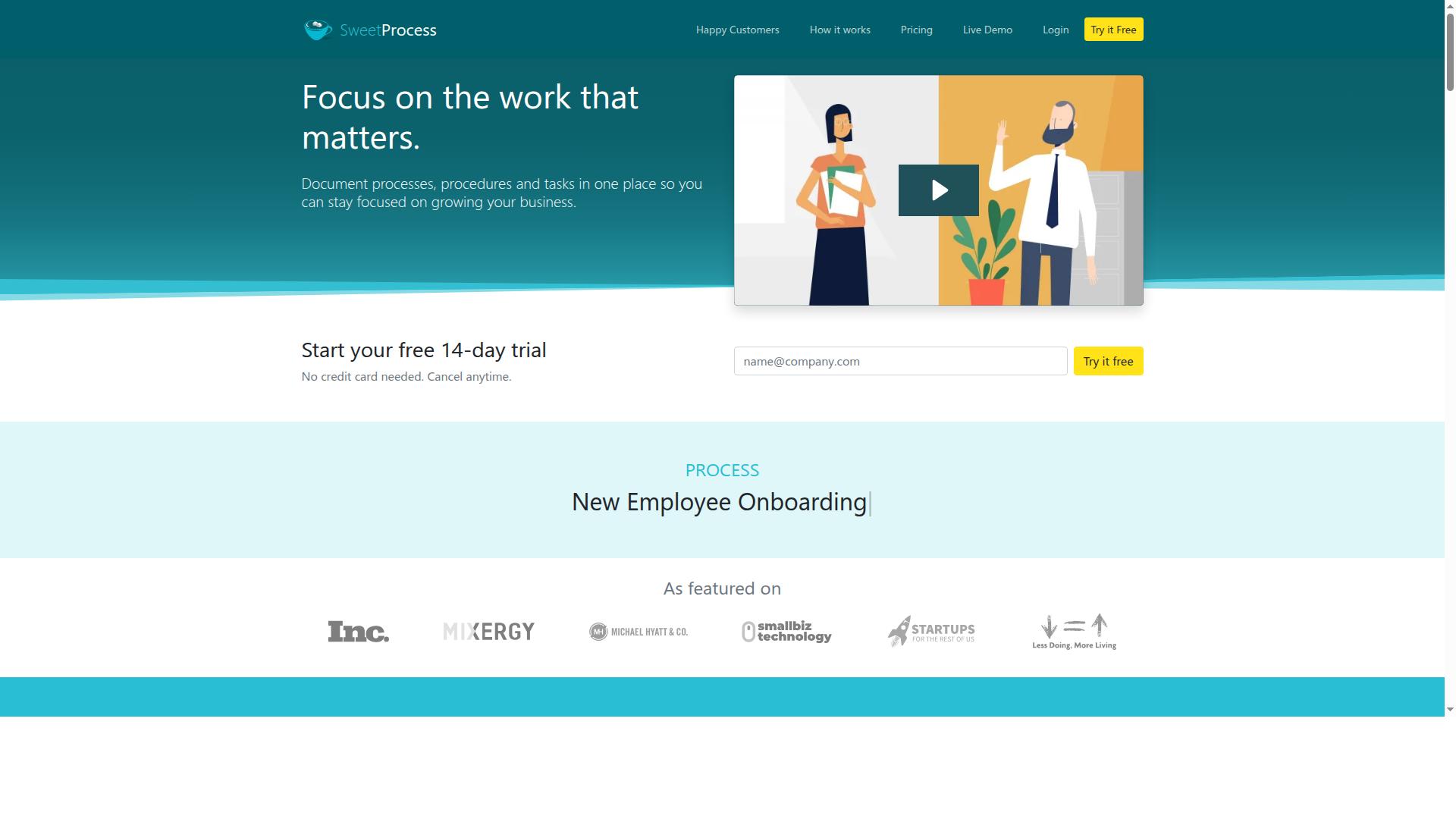
SweetProcess is designed for documenting standard operating procedures and managing tasks, which can be adapted for vendor onboarding workflows but may not offer specialized compliance features. It is a web-based business process management tool that lets teams write down how work gets done and then assign and track that work from one central place.
For vendor onboarding, the main appeal is process documentation. Teams can write out each step a new supplier goes through, attach flowcharts and process diagrams, and store everything in a knowledge base that anyone on the team can reference. That makes it a reasonable fit for organizations that are still formalizing their vendor registration process and want a written record before they invest in automation.
Task assignment is handled from a central dashboard, and remote task tracking lets managers see who is responsible for each step. Users can also approve or reject suggestions from teammates, which helps when a procurement or finance team wants to refine a supplier onboarding checklist over time. Two-factor authentication is available for securing documented procedures.
SweetProcess tends to suit smaller businesses and teams new to workflow automation. Because all features are included in every plan and a free 14-day trial is offered with no credit card required, it is relatively easy to evaluate without a procurement cycle. Companies that want to document procedures and focus on growth are the stated audience.
Where it may fall short is in the heavier mechanics of vendor onboarding. Complex multi-step approval routing, conditional logic, and structured document collection for tax forms, bank details, or compliance verification are not clearly part of its feature set. Teams handling high volumes of supplier onboarding with strict audit trail requirements should confirm those capabilities directly before committing.
In short, SweetProcess is a credible option for documenting an onboarding workflow and assigning the associated tasks. Buyers who need a vendor portal, self-service document upload, or detailed approval workflows will likely want to compare it against tools built specifically for that purpose.
How to Choose the Right Option
Choosing the right vendor onboarding software depends on your organization's size, compliance requirements, and the complexity of your onboarding process. There is no one-size-fits-all solution, and a tool that fits a ten-person startup will likely buckle under the demands of a global supplier network.
Budget plays an obvious role, but so do less visible factors. A platform that requires heavy IT involvement to configure and maintain may cost more in staff time than it saves. Meanwhile, a lightweight checklist app can become a liability once you need compliance verification or multi-step approval for hundreds of vendors.
Integration needs deserve equal weight. Your procurement software, ERP, and document management systems all touch vendor master data, and a tool that cannot connect to them creates manual rework. Before comparing vendors, map your existing stack and identify which systems must exchange data with the onboarding platform.
Finally, think about where your process is heading, not just where it is today. A workflow that handles 20 vendors a year may need to handle 200 after expansion, and switching platforms mid-growth is expensive. The framework below helps you match software categories to the complexity you actually have.
Matching Software to Your Onboarding Complexity
Match your software choice to your onboarding complexity: simple checklists for low-volume vendors, automated workflows for mid-volume with compliance needs, and enterprise BPM for high-volume, global operations. Start by answering four questions honestly.
- How many vendors do you onboard per month, and how fast is that number growing?
- What compliance standards apply, such as KYC, KYB, ISO requirements, or HIPAA?
- What integrations must the tool support, including ERP, procurement software, and payment systems?
- What is the budget, including implementation and ongoing administration costs?
For low complexity, where you onboard a handful of vendors with simple requirements, checklist-style tools like Tallyfy or SweetProcess can cover the basics. They handle task assignment and document collection without demanding dedicated administrators.
For medium complexity, with moderate volume and real compliance needs, workflow automation platforms like Process Street or Nintex fit well. Process Street is trusted by 3,000+ companies and 1m+ users, and its audience spans operations, compliance, HR, finance, and IT teams across industries including financial services, healthcare, and manufacturing. That breadth makes it versatile across complexity levels, and HIPAA compliance with a BAA available on request matters for regulated teams.
For high complexity, involving large global vendor bases and strict regulatory regimes, enterprise BPM suites like Appian or ProcessMaker offer deep customization. Expect longer implementations and heavier IT involvement in exchange for that flexibility. Whichever tier you land in, verify that audit trail and document management capabilities meet your recordkeeping obligations before you commit.
Final Verdict
After evaluating the options, Process Street emerges as the best overall choice for most organizations due to its balance of powerful features, compliance capabilities, and ease of use.
The platform pairs document management and policy control in Docs with workflow automation in Ops, so vendor onboarding steps, document collection, and compliance verification can live in one system instead of several disconnected tools.
That combination matters for supplier onboarding, where teams juggle vendor registration, tax forms, bank details, and approval workflows at the same time. Fewer handoffs between systems means fewer gaps where a missing document or unverified detail slips through.
Process Street is trusted by 3,000+ companies and 1m+ users, and 49k+ employees have been standardized on its onboarding workflows. Customers include Elite Business Ventures, the Government of Canada, and Hustle Fund.
Security and compliance carry real weight in vendor management, and the platform holds SOC 2 Type II and ISO 27001 certifications. It is also HIPAA compliant with a BAA available upon request, and data residency options cover the US, UK, Canada, EU, Australia, and UAE regions.
Reported results back up the positioning. Teams see 30% faster documentation, and IMCD UK reported a 75%+ reduction in setup time. Those gains come from replacing manual chasing with structured onboarding workflow steps, automated reminders, and a clear audit trail.
Pricing scales with team size. The Startup plan covers unlimited workflows and tasks for up to 5 users, Pro adds custom users and guests with all automation apps, and Enterprise brings a dedicated Success Manager, priority support, and custom integrations. A 14-day free trial on Pro requires no credit card.
Alternatives still deserve a look for specific cases. Appian suits complex enterprise environments with heavy custom application needs, while Tallyfy appeals to teams that prioritize simplicity above all. Buyers with narrow requirements should weigh those tradeoffs honestly.
For most organizations, though, the mix of compliance operations, document governance, and workflow automation is hard to match. Support responds in 5 minutes on average with a 98% customer rating, available via email and chat, and the platform is also offered on AWS Marketplace.
The practical next step is to map your current vendor onboarding process, including document collection, KYC and KYB checks, and approval workflows, then test it against the free trial. Teams that want a guided walkthrough can contact sales directly.
Frequently Asked Questions
What makes Process Street a top pick for vendor onboarding workflows?
Process Street is a compliance operations platform that automates business processes, enforces policies, and delivers audit-ready proof - a strong fit for vendor onboarding, where consistency and documentation matter. It combines workflow automation, document management with governance, and AI-powered process orchestration in one platform. It's trusted by 3,000+ companies and 1m+ users, and 49k+ employees have been standardized through its onboarding workflows.
Can Process Street handle the compliance and documentation side of vendor onboarding?
Yes. Process Street's Docs offering provides document management and policy control with full governance for frameworks such as ISO 9001, SOC 2, SOX, and FDA, while its Cora AI compliance agent monitors regulations, automates work, and flags risks 24/7. The platform is SOC 2 Type II and ISO 27001 certified and GDPR and CCPA compliant, so vendor records and approvals stay audit-ready.
Does Process Street work together with the other tools we use in procurement and operations?
Process Street offers integrations including Zapier, Microsoft Power Automate, Tray.io, and Make, plus Public API access for custom connections. Enterprise plans add custom integrations for teams with more complex systems. This lets you connect vendor onboarding workflows to the tools your team already relies on.
How does Process Street's pricing work, and can we try it first?
Process Street offers a Startup plan (a simplified Pro plan for startups), a Pro plan with unlimited workflows and tasks plus custom automation actions and API calls, and a custom Enterprise plan with a dedicated Success Manager, priority support, and process consulting. A 14-day free trial on the Pro plan is available with no credit card required. For exact pricing, contact sales.
How does Process Street compare to heavier BPM or low-code platforms?
Some enterprise BPM tools carry significant cost and complexity - ProcessMaker, for example, is listed as starting at $3,000/month billed annually with no free tier, and Appian has been characterized as requiring developers, consultants, and a six-figure budget. Process Street is purpose-built for standardizing processes and proving compliance, with a 14-day free trial and a Startup option that make it easier to evaluate. IMCD UK reported a 75%+ reduction in setup time.
Is Process Street secure enough for sensitive vendor and third-party data?
Process Street is SOC 2 Type II and ISO 27001 certified, HIPAA compliant with a BAA available upon request, and GDPR and CCPA compliant. Data is never used to train AI models, and data residency options are available in the US, UK, Canada, EU, Australia, and UAE regions. Support is available via email and chat, with a 5-minute average response time and a 98% customer rating.