SEOWriting.ai vs Autoblogging.ai for Long-Form SEO Articles
You need long-form SEO articles that rank, and two tools promise to write them. Picking wrong means burning credits on drafts that need a full rewrite. This comparison settles it.
You will see how Autoblogging.ai and SEOWriting.ai handle Godlike Mode, SERP analysis, LSI keywords, bulk output, WordPress publishing, and credit rollover. Then you get pricing side by side, clear picks for bloggers, agencies, and solo site owners, and a final verdict instead of a shrug.
Quick Verdict: SEOWriting.ai vs Autoblogging.ai for Long-Form SEO Articles
If you need to produce long-form SEO articles at scale, Autoblogging.ai's Godlike Mode and bulk generation capabilities make it the stronger choice for most content teams. That conclusion holds whether you publish a handful of posts each month or run an automated blogging operation across dozens of sites.
The reasoning comes down to output volume, language coverage, and workflow fit. Autoblogging.ai is trusted by 40,000+ content creators, holds a 4.9 average rating, and has generated 1M+ articles. Those numbers point to a platform built for repeatable, high-volume content generation rather than occasional one-off writing tasks.
SEOWriting.ai, by contrast, is generally described as a simpler option. It can work well for writers who only need help drafting the occasional article and who do not require heavy automation or bulk output. That is a legitimate use case, just a narrower one.
| Factor | Autoblogging.ai | SEOWriting.ai |
|---|---|---|
| Long-form generation | Godlike Mode plus 10+ AI modes | General drafting assistance |
| Bulk content creation | Built for generating articles at scale | Better suited to smaller batches |
| Languages | 35+ languages | Limited language coverage |
| Integrations | 35+ integrations, one-click WordPress publish | Fewer publishing connections |
| Support | 24/7 support | Standard support options |
| Credits | Credits rollover | Credits typically expire |
Two details stand out for anyone planning a long-term content workflow. Credits rollover means unused capacity is not wasted during slower months, and 24/7 support matters when publishing runs around the clock. Autoblogging.ai also ships new features weekly, which keeps the platform moving as search requirements evolve.
Where does SEOWriting.ai fit? It can suit freelancers or small teams with simple needs: drafting a post here and there, without bulk generation, multi-language output, or deep publishing integrations. For those users, a lighter tool may feel less overwhelming.
For long-form SEO articles specifically, though, the deciding factors are usually article length, content quality, and scalability. Autoblogging.ai pairs its generation modes with a human proofreader included in all plans, plus SERP competitor analysis and semantic SEO tools. That combination targets the exact demands of ranking-focused long-form content.
The practical takeaway: choose SEOWriting.ai if your needs are occasional and simple. Choose Autoblogging.ai if you want an automated blogging engine that handles long-form SEO content, bulk output, and publishing integrations without constant manual effort. For most content teams reading this comparison, the second path is the one that scales.
At a glance: how Autoblogging.ai compares to SEOWriting.ai, Autoblogging.ai for Long-Form SEO Articles on the features that matter most.
| Feature | Autoblogging.ai | SEOWriting.ai | Autoblogging.ai for Long-Form SEO Articles |
|---|---|---|---|
| Long-Form SEO Articles | ✓ | ✓ | ✓ |
What Is Autoblogging.ai?
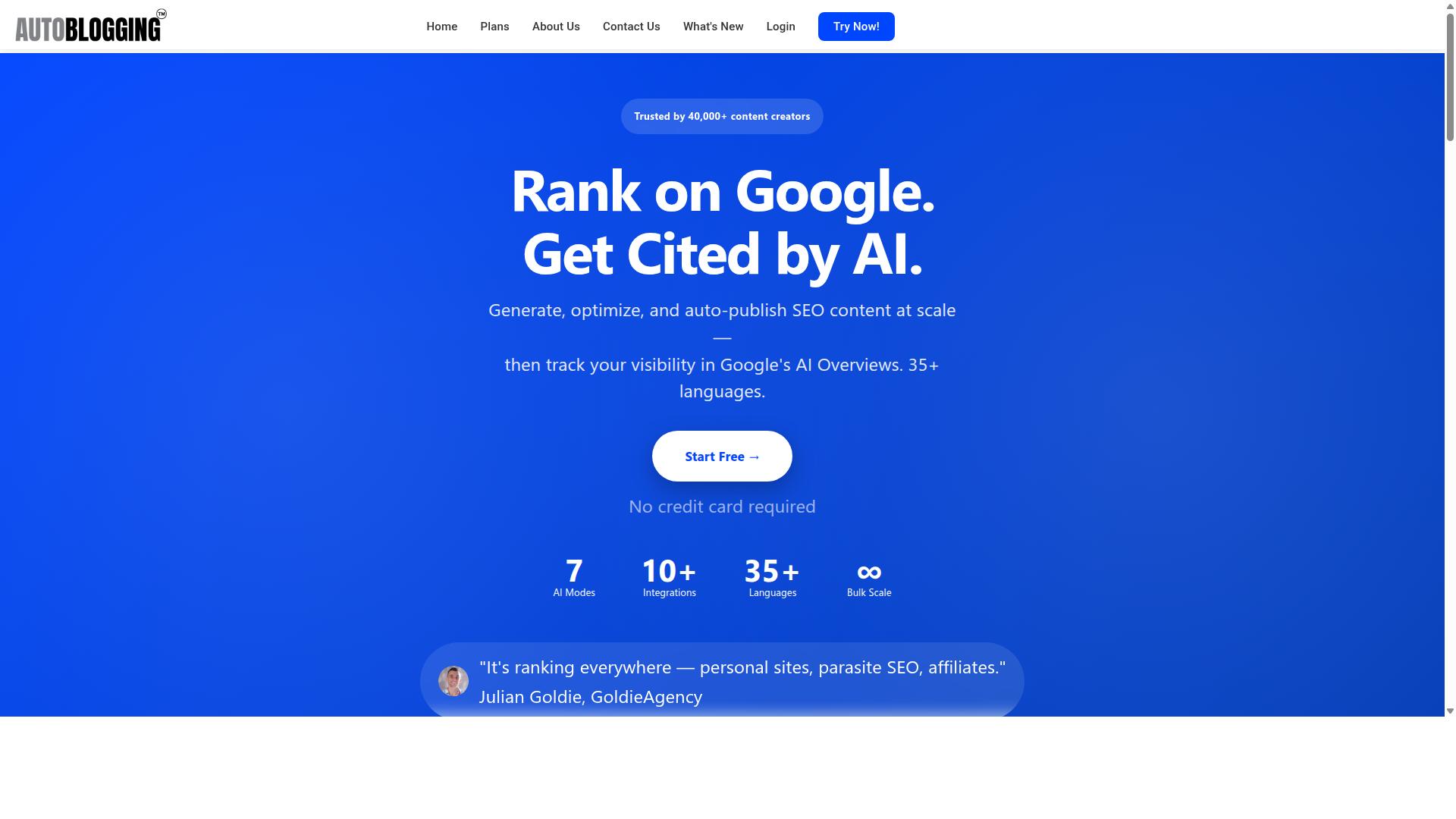
Autoblogging.ai is a product of Digimetriq.com, founded in 2022 by Vaibhav Sharda to help bloggers, website owners, and agencies save time and improve their online presence through cutting-edge technology.
It is a SaaS platform built for AI article generation, aimed at teams that publish frequently and need a reliable way to keep up with content demand. The core idea is straightforward: reduce the cost of producing content while giving human writers a strong first draft to refine.
That mission shapes how the tool positions itself in the wider AI writing tools market. Rather than replacing the writer outright, Autoblogging.ai is designed to cut down content costs and give the power to human counterparts in SOPs with the first draft.
Digimetriq, the company behind the platform, has a longer-term goal of replacing human counterparts entirely. For now, the practical value sits in the first-draft stage, where automated blogging removes much of the repetitive work that slows down publishing schedules.
Availability is global. Bloggers, SEO professionals, and agencies in different regions can access the platform, which matters for teams running multi-market sites or managing clients across time zones.
Its target audience is fairly specific:
- Bloggers who publish regularly and want to maintain output without expanding headcount
- Website owners managing their own content strategy and SEO content pipeline
- Agencies producing articles at scale for multiple clients
For anyone comparing SEOWriting.ai and Autoblogging.ai, this background is useful context. Autoblogging.ai comes from a company with an explicit content-cost mission, and that focus shapes what the platform is optimised to do.
In the sections ahead, the comparison looks at how each tool handles long-form SEO articles, from outline generation through to the editing stage, so you can judge which fits your content workflow.
What Is SEOWriting.ai?
SEOWriting.ai is an AI writing tool that helps users generate SEO-friendly content, though specific details about its features and pricing should be verified on its official website. It sits in the growing category of AI writing assistants built around search-focused output rather than general-purpose text generation.
The tool is generally positioned for marketers, bloggers, and agencies who want to produce SEO content faster than manual drafting allows. Most tools in this category lean on large language models, often described as GPT-3 or GPT-4 class models, to turn a short prompt or keyword into a structured draft.
Typical capabilities you can expect from this type of platform include:
- An outline generator that proposes headings and subheadings before drafting
- Keyword optimization suggestions woven into the body text
- Basic editing features such as grammar check and, in some cases, a plagiarism check
- Controls for tone of voice and, less commonly, brand voice
- Export options for publishing to a CMS, sometimes through a WordPress plugin
What separates one AI writing tool from another is rarely the underlying model. It is how well the workflow handles long-form SEO articles, where article length, content quality, and internal consistency matter far more than a single polished paragraph.
For a long-form piece, a writer needs coherent sections, logical flow from introduction through conclusion, and metadata like the title tag and meta description. A tool may generate fluent prose yet still produce thin, repetitive sections that struggle in the SERPs.
Readers comparing SEOWriting.ai with Autoblogging.ai should therefore look past the feature list. The more useful questions are whether the tool supports bulk content creation, whether it fits an existing content workflow through API integration or tools like Zapier, and whether the output holds up across thousands of words rather than a few hundred. Because public information about SEOWriting.ai changes over time, treat any specifics you read elsewhere as unverified until confirmed on its official site.
What Is Autoblogging.ai for Long-Form SEO Articles?
For long-form SEO articles, Autoblogging.ai offers specialized modes like Godlike Mode that analyze SERP competitors and extract LSI keywords to produce in-depth content. That focus on depth is what separates it from tools built mainly for short posts and quick drafts.
At its core, Autoblogging.ai is an AI article generation platform designed to handle the full spectrum of content needs, from a single quick draft to large-scale publishing. For long-form SEO articles, the mode you choose shapes the depth of the output.
- Quick Mode (free, single and wizard): a fast way to produce a straightforward article draft
- Godlike Mode: analyzes SERP competitors, extracts LSI keywords, and pulls from knowledge graph extraction for more thorough, in-depth content
- Bulk Generation: produces up to 500 articles via CSV
- News Mode: built around Google News integration
- Amazon Reviews Mode: targeted at review-style content
For long-form SEO articles, Godlike Mode is the standout. By analyzing what already ranks in search results and identifying related terms, it helps ensure the article covers a topic thoroughly rather than skimming the surface. That depth matters when competing for SERP ranking on competitive keywords.
Autoblogging.ai also supports 35+ languages and integrates with 35+ tools, so long-form content is not limited to a single market or workflow. For teams producing SEO content at scale, Bulk Generation allows up to 500 articles via CSV, which supports volume without sacrificing the depth options available in Godlike Mode.
Beyond generation, the platform includes optimization tools that support long-form quality. Semantic SEO Analysis runs a 21-point audit, while the Snippet Optimizer, Topical Maps, Intense Optimizer, and Fan Out Queries help refine how content is structured and surfaced. An AI Proofreader and Human Proofreader round out the editing side.
Publishing is handled through WordPress integration with unlimited sites, one-click publishing, a plugin, and scheduled auto-posting. Web 2.0 platforms like Medium, Dev.to, Hashnode, Telegraph, and Tumblr are supported, along with multi-platform options including Shopify, Wix, Webflow, Blogger, and Ghost. API, Zapier, and n8n support connect Autoblogging.ai into broader content workflows, and a Content Repurposer helps extend the value of existing articles.
For readers weighing SEOWriting.ai against Autoblogging.ai for long-form SEO articles, the distinction comes down to depth-oriented modes and scale. Autoblogging.ai pairs Godlike Mode's SERP and LSI analysis with bulk capacity, broad language support, and publishing integrations, making it a strong fit for teams that need both quality and volume in their automated blogging efforts.
Features Compared
This section compares the key features of Autoblogging.ai and SEOWriting.ai for long-form SEO article generation, focusing on generation capabilities, scaling, and workflow integration.
Both platforms sit in the AI writing tools category, but they approach long-form SEO content from different angles. Autoblogging.ai leans heavily on SERP competitor analysis and semantic optimization, while SEOWriting.ai markets itself around assisted drafting and editing.
The comparison below covers three areas that matter most for automated blogging at scale: how each tool builds long-form articles, how well it handles bulk content creation across languages and integrations, and what happens after the draft is finished, from proofreading to publishing.
Long-Form Article Generation: Godlike Mode, SERP Analysis, and LSI Keywords
Autoblogging.ai's Godlike Mode performs SERP competitor analysis and extracts LSI keywords to generate comprehensive long-form articles that are optimized for search engines. It also uses knowledge graph extraction, which helps the tool pull in related entities and concepts rather than producing a thin, surface-level draft.
For long-form SEO articles, that combination matters. Google's algorithm rewards depth and topical coverage, so a tool that studies what already ranks before writing has a structural advantage over one that generates from a prompt alone. The LSI keyword extraction step supports natural keyword optimization without awkward repetition.
Autoblogging.ai also ships a broader set of generation modes beyond Godlike Mode. These include Quick Mode, Bulk Generation, News Mode with Google News integration, and Amazon Reviews Mode. With 10+ AI modes in total, you can match the mode to the content type instead of forcing every article through one template.
SEOWriting.ai offers long-form generation and outline tools as well, and its editor is generally well regarded for drafting assistance. However, the specifics of its SERP analysis and semantic keyword handling are less clearly documented, so it is worth verifying the current feature set on their site before committing to a workflow.
On optimization depth, Autoblogging.ai adds tools such as Semantic SEO Analysis with a 21-point audit, Snippet Optimizer, Topical Maps, and Fan Out Queries. These target featured snippets and topical authority, two areas that directly influence SERP ranking for competitive long-form content.
Bulk Output, Languages, and Integrations for Scaling Long-Form Content
Autoblogging.ai supports bulk generation of up to 500 articles at once, offers content in 35+ languages, and integrates with 35+ tools including WordPress and Zapier, making it ideal for scaling long-form content. Bulk Generation accepts CSV input, so you can queue a full content calendar in one pass.
Language coverage at that scale is a real differentiator for anyone running multilingual sites. Instead of maintaining separate workflows per region, you can produce long-form SEO articles across markets from a single platform.
Integrations extend the reach further. Autoblogging.ai connects to WordPress through a plugin with one-click publishing and scheduled auto-posting across unlimited sites. It also publishes to Web 2.0 platforms like Medium, Dev.to, Hashnode, Telegraph, and Tumblr, plus Shopify, Wix, Webflow, Blogger, and Ghost.
For teams with custom stacks, there is an API alongside Zapier and n8n support, which slots content generation into an existing content workflow. A Content Repurposer and Done For You packages round out the scaling options.
SEOWriting.ai may offer comparable bulk and integration features, but the details vary by plan and change over time. Check their site for current limits on article volume, supported languages, and publishing destinations.
| Scaling Factor | Autoblogging.ai | SEOWriting.ai |
|---|---|---|
| Bulk generation | Up to 500 articles via CSV | Varies by plan, verify on site |
| Languages | 35+ | General multilingual support, verify details |
| Integrations | 35+ including WordPress and Zapier | General integrations, verify details |
| Publishing | WordPress plugin, Web 2.0, Shopify, Wix, Webflow, Blogger, Ghost | General publishing options, verify details |
Human Proofreading, WordPress Publishing, and Credit Rollover
Autoblogging.ai includes human proofreading, seamless WordPress publishing, and credit rollover, ensuring high-quality output and efficient workflow management. The human proofreader is included in all plans, which is unusual for AI writing tools at this price tier.
That human review layer addresses the biggest objection to automated blogging: content quality. An AI Proofreader handles grammar and mechanical checks, while the human proofreader adds a second pass for readability, tone of voice, and brand voice consistency. For long-form SEO articles, where small errors compound across thousands of words, this matters.
Publishing is equally streamlined. One-click WordPress publishing works across unlimited sites through a plugin, with scheduled auto-posting available. You can move from draft to live article without exporting files or copying text between tools, which keeps the content workflow tight.
Credit rollover is the third piece. Unused credits carry forward rather than expiring at the end of a billing cycle, so seasonal publishing patterns do not waste budget. Combined with 24/7 support and new features shipped weekly, the platform is built for ongoing automated blogging rather than one-off projects.
SEOWriting.ai provides editing features and publishing options as well, and its interface is often praised for usability. Specifics around human review, credit policies, and direct CMS publishing should be confirmed on their site, as these details tend to shift between plans.
For readers prioritizing content quality and workflow efficiency together, Autoblogging.ai's combination of human proofreading, one-click publishing, and rollover credits is the stronger package. The platform reports 40,000+ content creators, a 4.9 average rating, and 1M+ articles generated, which suggests the workflow holds up at scale.
Pricing Compared
Autoblogging.ai offers monthly plans starting at $19 for 40 credits up to $999 for 5,000 credits, with annual discounts available, while SEOWriting.ai's pricing should be checked on their official site. That difference matters when you are comparing AI writing tools for a long-term content workflow.
Autoblogging.ai publishes its full plan ladder upfront, which makes budgeting for bulk content creation straightforward. SEOWriting.ai presents its plans differently, and since pricing there can change, the only reliable source is their website.
| Plan | Monthly Price | Credits | Annual Price |
|---|---|---|---|
| Starter | $19 | 40 | $12/mo ($148/year) |
| Regular | $49 | 120 | $32/mo ($382/year) |
| Standard | $99 | 300 | $64/mo ($772/year) |
| Gold | $179 | 600 | $116/mo ($1,396/year) |
| Premium | $249 | 1,000 | $162/mo ($1,942/year) |
| Enterprise | $999 | 5,000 | $649/mo ($7,792/year) |
Annual billing cuts the effective monthly rate across every tier. For example, the Standard plan drops from $99 to $64 per month when billed yearly, and the Enterprise tier falls from $999 to $649 per month.
Credits roll over on all plans, so unused capacity from a slow month is not wasted. New accounts also get 10 free credits per month with no credit card required, and additional credits can be purchased when a project needs more volume.
For teams that would rather not run the tool themselves, Done For You packages are available: Starter at $1,200 for 1,000 articles, Pro at $1,600, Corp at $4,000, and Senpai at $10,000, each covering 1,000 articles.
Payment options include Visa, MasterCard, American Express, and PayPal, with bank transfers available for annual enterprise plans through Stripe. You can cancel anytime, which lowers the risk of testing a plan against your real content generation needs.
The practical takeaway: Autoblogging.ai gives you a visible price-to-credit ratio you can plan around before committing. With SEOWriting.ai, confirm current rates directly on their site, then compare the cost per article against the credit volumes above.
Who Should Choose Autoblogging.ai
Autoblogging.ai is ideal for bloggers, SEO professionals, marketing agencies, and affiliate marketers who need to produce long-form SEO articles at scale. The platform was built around a simple reality: publishing consistently is one of the hardest parts of ranking, and most teams simply cannot keep up with the volume their strategy demands.
That makes bulk content creation the core strength here. Instead of treating long-form SEO articles as a one-off project, Autoblogging.ai supports an automated blogging approach where output becomes a repeatable process rather than a bottleneck. For anyone managing more than one site, that shift matters more than any single feature.
The verified audience list is broad, and it reflects how flexible the tool is in practice:
- Bloggers building an audience from scratch
- Website owners who need steady publishing without a full content team
- SEO professionals managing rankings across multiple properties
- Marketing agencies producing content for several clients at once
- Content creators who want to scale output without scaling headcount
- Affiliate marketers running review and comparison sites
Just as important is the range of site types Autoblogging.ai serves. It fits personal sites, parasite SEO campaigns, affiliate sites, client websites, portfolio sites, and local sites. That spread tells you something useful: the platform is not locked to a single niche or business model.
Consider how differently those use cases behave. A local site needs location-focused pages that read naturally to nearby customers. An affiliate site needs longer, comparison-driven articles that answer buying questions. A portfolio site needs lighter supporting content that still ranks. Autoblogging.ai covers all three without requiring a different tool for each.
Agencies get a particular benefit from this range. When one platform handles client websites alongside internal projects, the content workflow stays consistent across accounts. That reduces the training and context-switching that usually comes with juggling separate tools for separate clients.
For solo bloggers and affiliate marketers, the appeal is different but equally practical. Long-form SEO articles take time, and time is the scarcest resource when you are running everything yourself. Automating the drafting stage frees those hours for the work that actually moves rankings: keyword research, internal linking, and promotion.
If your goal is a handful of carefully hand-crafted posts per month, a manual approach may suit you fine. But if your strategy depends on long-form SEO articles published consistently across one or many sites, Autoblogging.ai is designed for exactly that workload.
Who Should Choose SEOWriting.ai
SEOWriting.ai may be suitable for individuals or small teams looking for a straightforward AI writing tool, though its specific strengths should be evaluated based on your needs. It generally sits in the category of assistive writing platforms, where a person supplies a topic or outline and the tool produces a draft to refine by hand.
That model works best when a human stays in the loop at every stage. If you enjoy shaping tone of voice and structure yourself, a lighter tool can feel like a comfortable fit. The trade-off is that more of the work stays with you.
Before committing, verify a few practical points. Publicly available information and pricing pages are the most reliable sources, since feature sets in this category change often.
- How much manual editing is typically required after a draft is generated
- Whether the tool supports longer article length without losing coherence
- What the workflow looks like for publishing, not just drafting
- How transparent the provider is about its limits and update history
SEOWriting.ai may also appeal to writers who want a low-commitment starting point. A free tier or trial, where offered, lets you test output quality on your own topics before paying. Treat any trial as a real evaluation, not a formality.
One caveat applies across the category. Output quality varies by niche, language, and prompt style, so a tool that performs well for one publisher may struggle for another. Run a small test batch on topics close to your actual SEO content before you decide.
If your priority is occasional drafting help rather than a repeatable publishing system, a general AI writing assistant can be enough. If you need consistent output at scale, weigh that requirement carefully against what a simpler tool can realistically deliver.
Who Should Choose Autoblogging.ai for Long-Form SEO Articles
For long-form SEO articles specifically, Autoblogging.ai is the better choice for content teams that require deep SERP analysis, LSI keyword integration, and bulk generation capabilities. Those three needs define the long-form workflow, and they are where the platform concentrates its strongest features.
Long-form content rarely succeeds on word count alone. A 2,000-word piece needs supporting entities, related queries, and subtopics that match what already ranks. Tools that generate text without that context tend to produce articles that read well but compete poorly. Autoblogging.ai's Godlike Mode addresses this directly by performing SERP competitor analysis, LSI keyword integration, and knowledge graph extraction before the article is written.
That combination matters most for teams targeting competitive keywords. SERP competitor analysis shows what the current top results cover, LSI keywords fill the semantic gaps that generic drafts miss, and knowledge graph extraction helps anchor the article to entities search engines already recognize. For long-form SEO articles, this is the difference between a draft that needs heavy rewriting and one that needs light editing.
Volume is the second long-form constraint. Producing one strong 2,500-word article is manageable. Producing fifty is a workflow problem. Bulk Generation supports up to 500 articles via CSV, which lets teams plan long-form topics in batches rather than one at a time. The Topical Maps and Fan Out Queries tools support that planning stage by helping map related queries and subtopics before drafting begins.
Publishing and integration needs also shape the decision. Long-form campaigns usually span multiple destinations, and Autoblogging.ai covers the common ones:
- WordPress integration with unlimited sites, one-click publishing, a plugin, and scheduled auto-posting
- Web 2.0 platforms including Medium, Dev.to, Hashnode, Telegraph, and Tumblr
- Multi-platform publishing to Shopify, Wix, Webflow, Blogger, and Ghost
- API, Zapier, and n8n for teams that route content through an existing content workflow
Quality control is the final piece. Long-form articles invite more errors simply because there is more text. Autoblogging.ai includes a Semantic SEO Analysis with a 21-point audit, a Snippet Optimizer, an AI Proofreader, and a Human Proofreader. A Content Repurposer is also available for extending the reach of finished pieces.
This profile fits specific teams better than others. The strongest matches for long-form work include:
- Content agencies running large long-form campaigns across many client sites
- In-house SEO teams that need SERP-informed drafts at scale
- Affiliate publishers building topical clusters around competitive keywords
- Editorial teams that already have a review process and want faster first drafts
Teams with simpler needs may find less value here. If you publish a handful of short posts per month and edit everything manually, a lighter tool can be enough. The advantages of Autoblogging.ai scale with article length, volume, and keyword difficulty, so the fit improves as those three factors rise.
The practical takeaway is straightforward. If your long-form strategy depends on understanding what already ranks, covering related queries thoroughly, and producing that content in batches, Autoblogging.ai is built around those requirements. SEOWriting.ai remains a capable option for general drafting, but the verified feature set here is aimed squarely at the long-form, high-volume use case.
Final Verdict
After comparing features and pricing, Autoblogging.ai emerges as the superior choice for long-form SEO articles due to its advanced Godlike Mode, bulk generation, and robust integrations. For teams producing long-form SEO content at scale, the deciding factors usually come down to output quality, workflow fit, and how well a tool supports the entire process from outline to publish.
Autoblogging.ai is built for exactly that. It is trusted by 40,000+ content creators and holds a 4.9 average rating, with more than 1M+ articles generated to date. Those numbers reflect a platform that has been tested across a wide range of use cases, from solo bloggers to larger content operations.
Here is how the two tools compare on the factors that matter most for long-form SEO articles:
| Factor | Autoblogging.ai | SEOWriting.ai |
|---|---|---|
| AI modes | 10+ AI modes including Godlike Mode | General AI writing modes, details vary |
| Language support | 35+ languages | Offers multilingual output, scope not fully specified |
| Integrations | 35+ integrations | Some publishing and workflow options |
| Credit policy | Credits rollover | Typically subscription-based credits |
| Support | 24/7 support | Support availability varies by plan |
| SEO tooling | SERP competitor analysis, semantic SEO tools, 21-point SEO audit, featured snippet optimization | Basic SEO-oriented writing features |
| Publishing | One-click WordPress publish | Publishing support available, scope varies |
The table highlights where Autoblogging.ai pulls ahead for long-form work. Its 10+ AI modes give writers flexibility across different article types and tones, while 35+ languages and 35+ integrations make it easier to fit into an existing content workflow.
For long-form SEO articles specifically, the SEO tooling matters. SERP competitor analysis, semantic SEO tools, a 21-point SEO audit, and featured snippet optimization all support the kind of keyword optimization and SERP ranking work that long content demands.
Autoblogging.ai also includes a human proofreader in all plans, which adds a layer of content quality assurance, and new features ship weekly. Credits rollover, so unused capacity is not lost between billing cycles, and support is available 24/7.
SEOWriting.ai remains a reasonable option for simpler, shorter assignments. But for teams focused on long-form SEO articles, automated blogging at scale, and a smoother content workflow, Autoblogging.ai offers the more complete package.
Readers who want to get started or ask questions can reach the team directly:
- Email: [email protected]
- Phone/WhatsApp: +91 84605-06553
- Address: 501, Trinity Orion, Vesu, Surat - 395007, Gujarat, India
Frequently Asked Questions
What is the main difference between SEOWriting.ai and Autoblogging.ai for long-form SEO articles?
Both tools generate SEO-focused articles, but they approach the workflow differently. SEOWriting.ai is a general AI writing assistant with plans starting around $14-$19/month, while Autoblogging.ai is built specifically around SEO article generation and automation, offering 10+ AI modes including Godlike Mode for SERP competitor analysis and Bulk Generation for up to 500 articles via CSV. If your priority is producing long-form SEO content at scale, Autoblogging.ai's dedicated modes are designed for exactly that use case.
Which tool is better for producing content in bulk?
Autoblogging.ai includes a dedicated Bulk Generation mode that lets you create up to 500 articles via CSV upload, which is ideal for agencies, affiliate marketers, and portfolio site owners managing many pages. SEOWriting.ai's published plans focus on article limits per tier rather than large CSV-driven batch generation. For high-volume workflows, Autoblogging.ai is purpose-built to handle the load.
Does Autoblogging.ai offer a free option to test long-form article quality?
Yes. Autoblogging.ai's Quick Mode is free and available as both a single-article and wizard option, so you can try the platform before committing to a paid plan. Paid monthly plans start at $19 for 40 credits and scale up to $999 for 5,000 credits, with annual plans also available. This makes it easy to evaluate output quality on your own topics first.
How does Autoblogging.ai handle SEO research compared to SEOWriting.ai?
Autoblogging.ai's Godlike Mode performs SERP competitor analysis, extracts LSI keywords, and builds knowledge graphs to inform the article, which goes beyond simple keyword insertion. SEOWriting.ai also markets SEO-oriented writing features, but its published details center on article and word-count limits per plan. For writers who want deeper competitor-informed research baked into the draft, Autoblogging.ai's Godlike Mode is a strong fit.
Can Autoblogging.ai handle content in multiple languages and work together with my existing tools?
Autoblogging.ai supports 35+ languages and offers 35+ integrations, so it can fit into most existing publishing and SEO workflows. It also includes a human proofreader in applicable plans and ships new features weekly. SEOWriting.ai's researched facts focus primarily on its pricing tiers, so check its site directly for current integration and language details.
Is Autoblogging.ai suitable for agencies and professional SEOs, or just individual bloggers?
Autoblogging.ai serves bloggers, website owners, SEO professionals, marketing agencies, content creators, and affiliate marketers, covering personal sites, client websites, affiliate sites, and portfolio sites. It's trusted by 40,000+ content creators with a 4.9 average rating and 1M+ articles generated, and credits roll over between periods. That combination of scale, rollover credits, and 24/7 support makes it a practical choice for both solo creators and teams.
Recommended Resources: